Find The Cat - Spot It!
- 4.9
- Rating
- 10.00M
- Installs
- Free
- Price

 Analysis by App-foxy
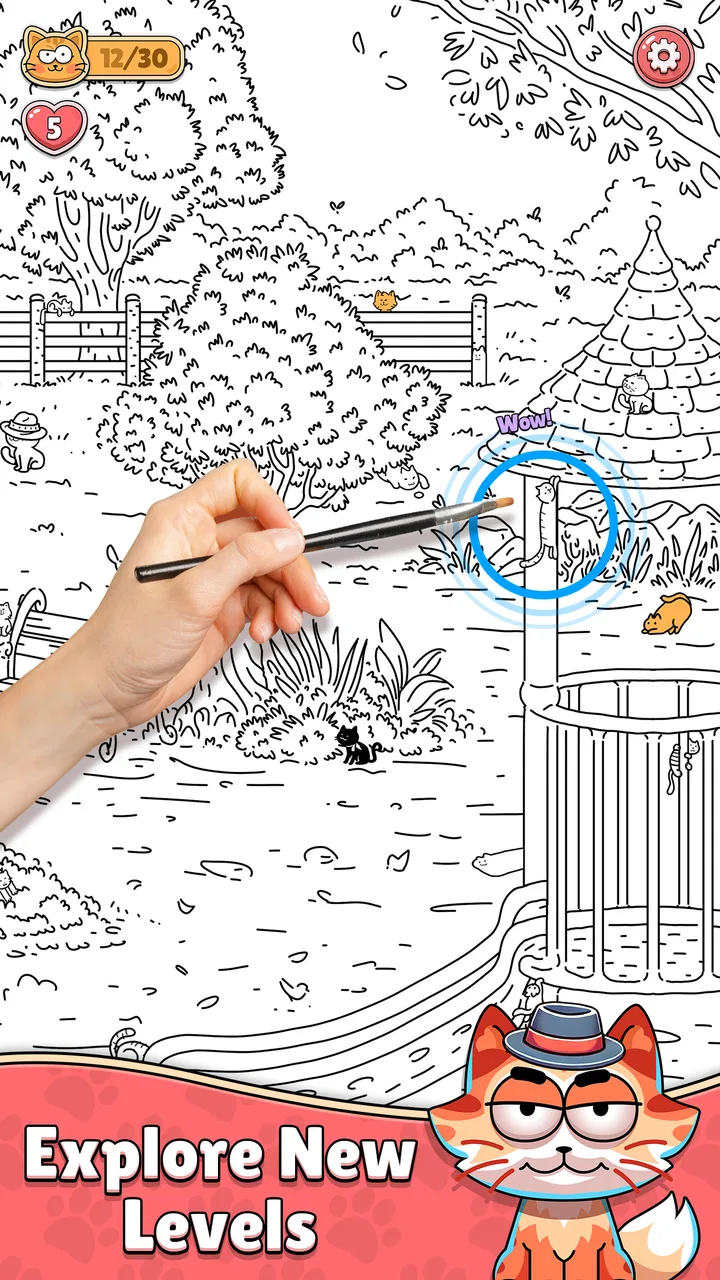
I expected a simple hidden-object game, but Find The Cat - Spot It! quickly showed me why this kind of puzzle can be so hard to put down. The idea is easy to understand: search each scene and locate the cats. What makes it enjoyable is the small shift from casual looking to deliberate observation. I found myself scanning corners, separating background details from meaningful shapes, and slowing down instead of tapping randomly.
That simplicity is the game’s biggest strength. It does not ask me to learn a complicated control scheme or follow a long story before I can play. I can open it for a short break, complete a search, and leave without feeling that I have abandoned a large commitment. At the same time, the visual hunting gives the experience more focus than an ordinary time-killer. It is a puzzle game built around attention, patience, and the satisfaction of noticing what was hiding in plain sight.
How the current version feels to play
Agave Games presents this as a free puzzle game for everyone, and that description matches my experience. The central task is friendly enough for younger players, while adults can still enjoy the challenge when a cat blends into a busy scene. The age rating is Everyone, and the tone feels much more suitable for relaxed family play than for players looking for action, competition, or a dramatic narrative.
You May Also Like

 Blood Strike: 2.5 Anniversary
Blood Strike’s Loadouts Turn Every Drop Into a Tactical Gamble
A close look at Blood Strike’s custom loadouts: how fast access to signature weapons reshapes its battle royale rhythm, rewards preparation, and narrows the gap between fights.

 Pandora - Music & Podcasts
Pandora’s Music Is Easy to Start, but Harder to Recover
Pandora’s strength is its low-effort path from a seed to a station. Its weak spot is how much confidence it asks you to place in connection, setup, and quiet recovery.

 8 Ball Pool
 Is Built on Rivalries, Rematches, and Routine
A close look at the rivalries, rematches, shared routines, and unanswered safety questions that turn a quick pool match into a persistent mobile community.

 Samsung Music
’s Quiet Strength Is Playing What You Already Own
Its reach comes less from spectacle than from dependable access to a personal library. That simplicity is both the app’s strongest retention engine and its ceiling.

 AccuWeather: Weather Radar
AccuWeather Review: A Quick, Clear Forecast for Everyday Decisions
For everyday plans, the best forecast is the one you can understand quickly. AccuWeather makes rain timing, radar, and local conditions easy to act on, with a few trade-offs.

 Hill Climb Racing
Why Hill Climb Racing Still Turns Crashes Into One More Run
A tiny car, a bumpy hill and one more upgrade: Hill Climb Racing keeps resurfacing because its simple chaos makes every near-miss feel personal.
More From Our News Desk



The opening appeal is immediate because the objective is so clear. I am not managing an inventory, matching complex combinations, or memorizing rules. I am looking at an image and trying to find the subject. That makes the game approachable for someone who rarely plays mobile games, including a relative who might find conventional puzzle menus intimidating.
What surprised me was how quickly “just find the cats” becomes a test of visual discipline. My first instinct was to sweep across the screen quickly, but that approach often made me overlook shapes that were partially covered or placed among similar colors. A better method is to divide the picture into sections, check each area once, and then return to the places where the background looks unusually crowded. This is one of the game’s quiet lessons: speed is not always the same as efficiency.
The controls support that kind of play because the interaction is direct. I spend most of my time studying the scene and tapping when I am confident. There is no need to remember a long sequence of gestures. That makes it comfortable on a phone, although the quality of the experience naturally depends on how much visual detail can be seen on the device’s screen. A larger display can make careful searching more comfortable, while a smaller phone may encourage zooming or closer inspection if the scene becomes dense.
One useful habit is to avoid treating every unusual object as a possible answer. Instead, I look for the visual traits that separate a cat from the surrounding decoration: a curved outline, a pair of ears, a compact body, or a familiar posture. This reduces random tapping and makes the search feel more like solving a visual riddle. It also helps when the scene contains many objects that are designed to compete for attention.
A good fit for short breaks and shared play
I can see myself using this game while waiting for an appointment, taking a short break from work, or winding down before bed. It does not require the same uninterrupted attention as a story-driven game, but it still gives a small sense of accomplishment. A single search can become a complete activity rather than an empty few minutes spent scrolling.
It also works well as a shared screen game. One person can hold the phone while another points out a suspicious corner, and the conversation naturally becomes part of the challenge. That is especially appealing for families because younger players can practice observation while adults provide hints without taking over completely. The game does not need to be competitive to be social.
There is a practical trade-off here. If I want a game with deep progression, character development, or strategic decision-making, this is not the right choice. Its pleasure comes from looking carefully, not from building a long-term system. Players who prefer constant novelty through combat, racing, or multiplayer competition may find the repeated search format too narrow.
What the numbers suggest about its place in the category
The game has earned a 4.9 average from around 648 thousand ratings, with roughly 12 thousand written reviews and more than 10 million installs. Those figures do not replace personal experience, but they do show that the straightforward hidden-cat concept has reached a large audience. It is not an obscure experiment that only appeals to a tiny group of puzzle fans.
It is free to install, which makes trying it easy. There are in-app purchases ranging from $0.99 to $8.99 per item, so I would still recommend checking the purchase flow before handing the phone to a child. The free entry point is helpful for deciding whether the visual search format suits you, but “free” does not mean every optional element will necessarily be available without spending.
Compared with traditional hidden-object games, the cat-focused concept gives the experience a clearer personality. Compared with match-three puzzles, it asks for observation rather than pattern construction. Compared with word games, it avoids language as the main barrier. That makes it a particularly sensible option for mixed-age households or anyone who wants a puzzle that can be understood almost instantly.
What has changed and what that means for players
The current release is version 4.5.1, and the game was released on August 29, 2024. I see that version number as a sign that the product has moved beyond its earliest launch state and is being maintained as an ongoing mobile game. I would not treat the number itself as proof of a specific feature, but it does matter when deciding whether the app feels like a finished, actively shaped experience rather than a one-off release.
For a new player, the practical benefit is simple: starting with the current version means experiencing the game as it exists now, rather than judging it by an early launch impression. For an existing player, updates can be valuable when they make the overall flow smoother or keep the search experience feeling fresh. At the same time, I prefer to separate what I can observe in the current build from what I hope future updates might bring. A version label alone cannot promise a particular improvement.
The minimum operating-system requirement is Android 10. That is important for anyone using an older phone or tablet. Before installing, I would check the device software rather than assuming that every Android handset can run it. This is a small detail, but it prevents the frustrating situation of finding a game that looks suitable and only discovering a compatibility problem at the last step.
Existing users are likely to appreciate the low learning curve when returning after a break. I do not need to relearn a complicated system before searching again. The familiar premise makes it easy to pick up, while the challenge comes from the individual scene in front of me. That makes the game more forgiving than puzzle titles whose enjoyment depends on remembering a large collection of rules.
There is also a less obvious benefit for returning players: the game rewards a change in method. If I am stuck, I do not necessarily need a hint or a faster tap. I can alter the way I inspect the image. I might look for repeated shapes, compare the left and right sides of a scene, or examine areas with unusual empty space. This gives the player a way to improve through technique rather than relying only on progression.
Small techniques that make searching easier
My most reliable approach is a three-pass scan. First, I inspect the broad composition and note the busiest areas. Second, I move in a consistent direction across the scene, checking each section without jumping around. Third, I revisit visual clusters where several objects overlap. This prevents the common mistake of repeatedly checking the same favorite corner while ignoring the rest of the picture.
Another useful technique is to search for negative space. A cat may be easier to recognize not by its entire body but by the gap around its outline. Looking at the empty area between objects can reveal ears, a tail, or a seated silhouette that disappears when I focus only on colorful details. This is especially helpful when the scene uses similar tones across many objects.
I also recommend changing the distance between my eyes and the screen instead of immediately tapping everywhere. Viewing the scene from a little farther away can make the overall silhouette stand out, while moving closer helps with small details. It sounds basic, but alternating between the two views is more effective than staring at the same scale until everything starts to blur together.
When playing with a child, I would give directional hints rather than naming the answer. “Look near the top,” or “check beside the large object,” keeps the child involved. That turns the game into an observation exercise instead of a race for the adult to locate every cat first. It is a small adjustment, but it changes the experience from passive watching to collaborative problem-solving.
Where the experience still has limits
The focused premise is also the main limitation. Once I understand the basic rhythm, the game’s appeal depends heavily on how much I enjoy examining pictures. There is no need to pretend it offers the broad variety of a full puzzle collection. Someone who wants logic grids, physics problems, word challenges, and number puzzles in one app will probably be better served by a general puzzle platform.
The visual format can also create moments of uncertainty. When a cat blends into a crowded scene, the challenge can feel satisfying, but if the distinction is too subtle, I may wonder whether I missed something because of poor technique or because the target is genuinely difficult to see. That is the point where a search game needs to balance clever hiding with readable design. I enjoy being challenged; I do not enjoy feeling that I am tapping at random.
Screen size is another real consideration. On a tablet, detailed scenes should be more comfortable to inspect because there is more room to study the composition. On a compact phone, I may need to hold the device closer or spend longer on each region. Anyone with eyesight concerns should try the free version first and judge whether the visual density feels comfortable before considering any purchase.
The monetization model may also affect the recommendation. Since the game is free but includes individual purchases from $0.99 to $8.99, I would be cautious about enabling unrestricted purchases on a shared device. For adults who simply want to test the format, that is unlikely to be a major obstacle. For families, setting purchase controls is sensible regardless of how inexpensive an individual item appears.
I would skip this game if my main goal were a long, narrative adventure or a demanding competitive puzzle ladder. It is better for calm concentration than for adrenaline. I would also choose a different option if I wanted puzzles that remain mechanically varied from one session to the next. Here, the pleasure is in the hunt for cats and in improving how I observe, not in mastering several unrelated systems.
Who should try it first
I would recommend it to people who enjoy hidden-object books, visual “spot the difference” activities, or gentle games that can be played in short sessions. It is also a good candidate for a family phone because the objective is easy to explain and the Everyone rating supports a broad audience. The free price makes the decision low-risk: install it, play enough to see whether searching feels relaxing or tedious, and then decide whether it deserves a permanent place on the device.
It is particularly suitable for players who like improving through attention. The game does not require fast reflexes, so a careful player can compete with their own previous performance rather than feeling disadvantaged by age or reaction speed. That makes it more inclusive than many mobile games that quietly reward rapid tapping.
For someone who regularly feels overwhelmed by complicated interfaces, this is another strong point. The core action is understandable without a tutorial-heavy introduction. I can show the game to another person and explain it in one sentence. That simplicity is not empty; it removes friction so the visual challenge can take center stage.
On the other hand, players who need a strong sense of progression should approach it with modest expectations. The game’s lasting value comes from the quality of its searches and the personal satisfaction of finding what was hidden. If I need unlockable systems, extensive customization, or a story that develops over many sessions, I would look elsewhere.
What I would watch as the game continues
Because the current version is 4.5.1, the most important future question is how Agave Games continues to keep the central search loop interesting. I would like to see the game preserve clear visual design while adding enough variety to prevent the scenes from feeling interchangeable. More challenge is welcome, but it should remain fair and readable rather than becoming difficult only because targets are too small or too well camouflaged.
I would also pay attention to how returning players are treated. A hidden-object game benefits from giving people a reason to come back without turning a relaxing activity into a stressful obligation. The best direction would be continued freshness around the same accessible idea, not unnecessary complexity that changes what made the game approachable in the first place.
For now, my recommendation is straightforward. This is a polished-feeling choice for anyone who wants a focused visual puzzle about locating cats, especially during short breaks or shared family play. Its free entry point, broad age rating, and simple controls make it easy to try. Just remember what it is: a specialized observation game, not an all-purpose puzzle collection.
After spending time with it, I found the strongest reason to keep playing was not the promise of a large system behind the scenes. It was the small mental reset that happens when I stop scrolling, study one picture, and finally notice the cat I had overlooked. If you enjoy calm searches that reward patience more than speed, this is an easy recommendation; if you need variety, story, or competition, choose a broader puzzle game instead.
FAQs for Find The Cat - Spot It!
01What is Find The Cat - Spot It! about?
Find The Cat - Spot It! is a fun and challenging game designed for cat lovers and puzzle enthusiasts. The main objective is to spot hidden cats in various intricate and detailed images. The game tests your observational skills and offers multiple levels of increasing difficulty, making it engaging for players of all ages.
02Is Find The Cat - Spot It! free to play?
Yes, Find The Cat - Spot It! is free to download and play. However, it may offer in-app purchases for additional features, such as hints or extra levels. These purchases are optional, allowing players to enjoy the basic gameplay without spending money, but they can enhance the gaming experience.
03What devices are compatible with Find The Cat - Spot It!?
Find The Cat - Spot It! is available for both Android and iOS devices. It requires Android version 5.0 and up or iOS 11.0 or later. The game is optimized for smartphones and tablets, providing a seamless experience across different screen sizes.
04Does Find The Cat - Spot It! require an internet connection?
No, Find The Cat - Spot It! can be played offline. This makes it a great option for entertainment during travel or in areas with limited internet access. However, an internet connection may be required for downloading updates or accessing certain in-app purchases.
05Are there any ads in Find The Cat - Spot It!?
Yes, the free version of Find The Cat - Spot It! includes advertisements. These ads help support the developers and keep the game free for all users. Players can choose to remove ads by making a one-time purchase, which also supports the game's continued development.
Pros
- Engaging and relaxing gameplay.
- High-quality
- adorable cat images.
- Improves observation skills.
- Frequent updates with new levels.
- Suitable for all ages.
Cons
- Limited levels may become repetitive.
- In-app ads can interrupt play.
- No offline mode available.
- Hints are limited without purchase.
- May not challenge advanced players.

Find The Cat - Spot It!
Gallery